Compensation Comparison
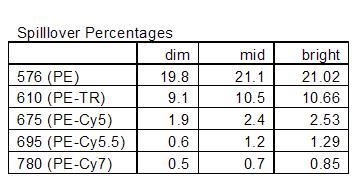
I often hear of people looking at a compensation matrix and deciding if it is “good” or “bad”. The actual values in themselves don’t give enough information to make this determination. Voltages can be set to give you almost any value for the compensation matrix, and spillover for a tandem can change over time as the reagent breaks down, resulting in different “correct” compensation values (one comparison of spillover from PE-Cy5 into PE was 45% for an old vial of reagent, vs 7% for an unopened one of the same lot at the same settings).
There is a stigma in flow against high compensation values, and their validity is called into question. ISAC 2010 had a session about minimizing the compensation values for a panel, which some saw as a useless exercise. From what I understand, this bias against high compensation is mostly a holdover from the early days of flow when compensation was done with pulse subtraction–a circuit would create a negative pulse proportional to the signal pulse in the primary channel to reduce the signal in the spillover channel and adjust for the spectral overlap. With small amounts of spillover this worked fine, but as you tried to compensate higher and higher values, it would be less accurate.
With the new digital systems today, the entire signal from each detector is quantified, and then compensation is applied mathematically. Depending on your system setup, it is possible that you could have greater than 100% compensation, meaning your signal in a spillover channel is higher than in your primary channel. This can still be valid, even though Diva gives an error message when that happens. Causes for this include 1.The “spillover” detector is set to a higher voltage, so that even if more photons are reaching the primary detector, the spillover detector gives a higher output, or 2.The primary detector has a very narrow bandpass filter, and/or the spillover channel has a very wide filter, so that more photons are actually reaching the spillover detector. While these conditions are not optimal, there is nothing incorrect about them. We are interested in identifying positive and negative events, so you could look at GFP in the “PE” detector and identify GFP positives, or some other non-optimal setup as long as you can get that separation, and it is still valid.
If you have FITC and PE single positive beads with negative beads, properly compensated, and look at histograms of FITC at a constant voltage, compared with PE over a range of voltages, the FITC signals are largely unaffected, while the PE+ is still identifiable over the full range, and just the separation changes:
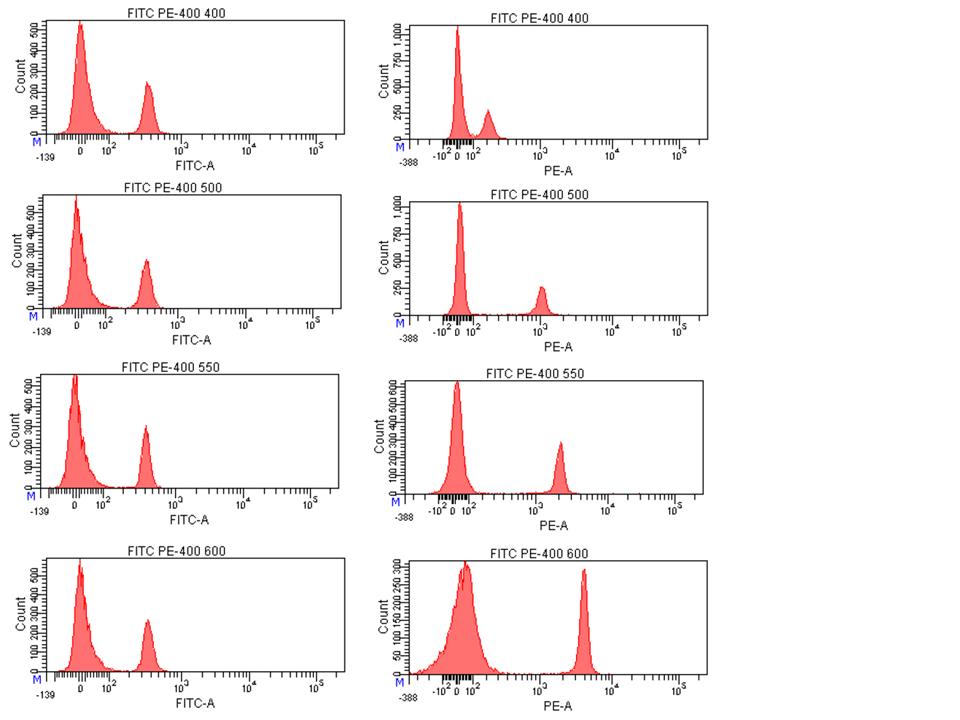
If you look at the compensation values, you will find a wide range,
| FITC/PE | 400/400 | 400/500 | 400/550 | 400/600 |
| PE- %FITC | 16.4 | 82.9 | 165.4 | 315 |
| FITC-%PE | 2.9 | 0.5 | 0.3 | 0.2 |
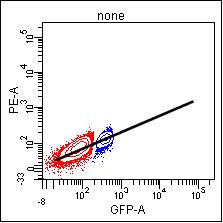
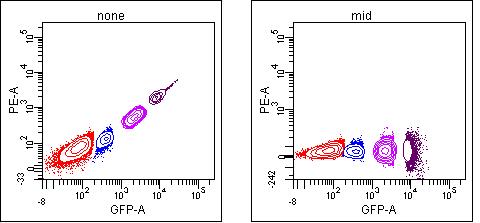
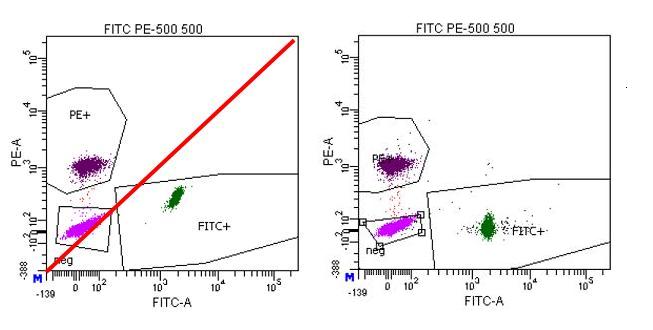
Even at 315% compensation (bottom panel), the peaks are identifiable and still separated in the histogram, but looking at dot plots can reveal more. At “normal” settings that give low spillover values, populations look normal–uncompensated on the left, compensated on the right, the red line being the boundary for “100% spillover”:
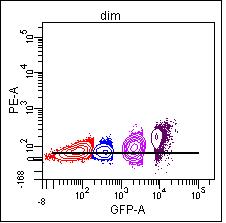
What can be observed at unbalanced settings is that events with a high signal in a given channel due to autofluorescence (or some other signal besides the fluor being compensated) can start to look strange when compensation percentages are very high—their high signal is NOT due to the fluor being compensated, so that “compensation” on those events is not accurate, and those bright autofluorescent populations will shift and cause strange plots:
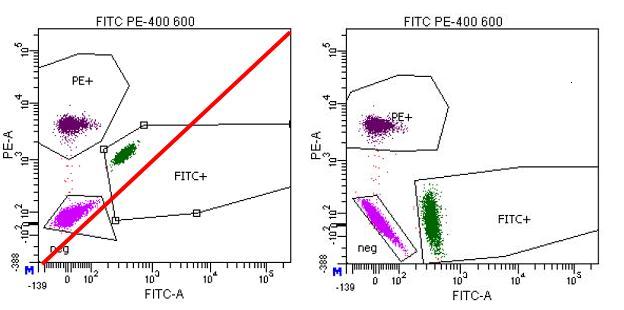
The “bright” autofluorescent shift down disproportionately at such high values, becoming inverted. So while compensation above 100% can be valid, it can start to cause some artifacts and aberrations in your plots.
High compensation values are an indication that your signals are high in another channel—this may be normal! Cy5 is excited by the 640 laser, and emits around 660, so PE-Cy5 has high spillover in the APC channel. When you have high spillover values, take it as a warning that your sensitivity for double positives in that spillover channel will be reduced. If your filter choices are optimized, you should be able to get the highest signal in the channel where you are measuring the fluorochrome of interest. Keeping the values below 100% is still preferred, to avoid distorting the negative populations, but as long as you have sufficient separation of your populations of interest, you should be able to get reliable data.